


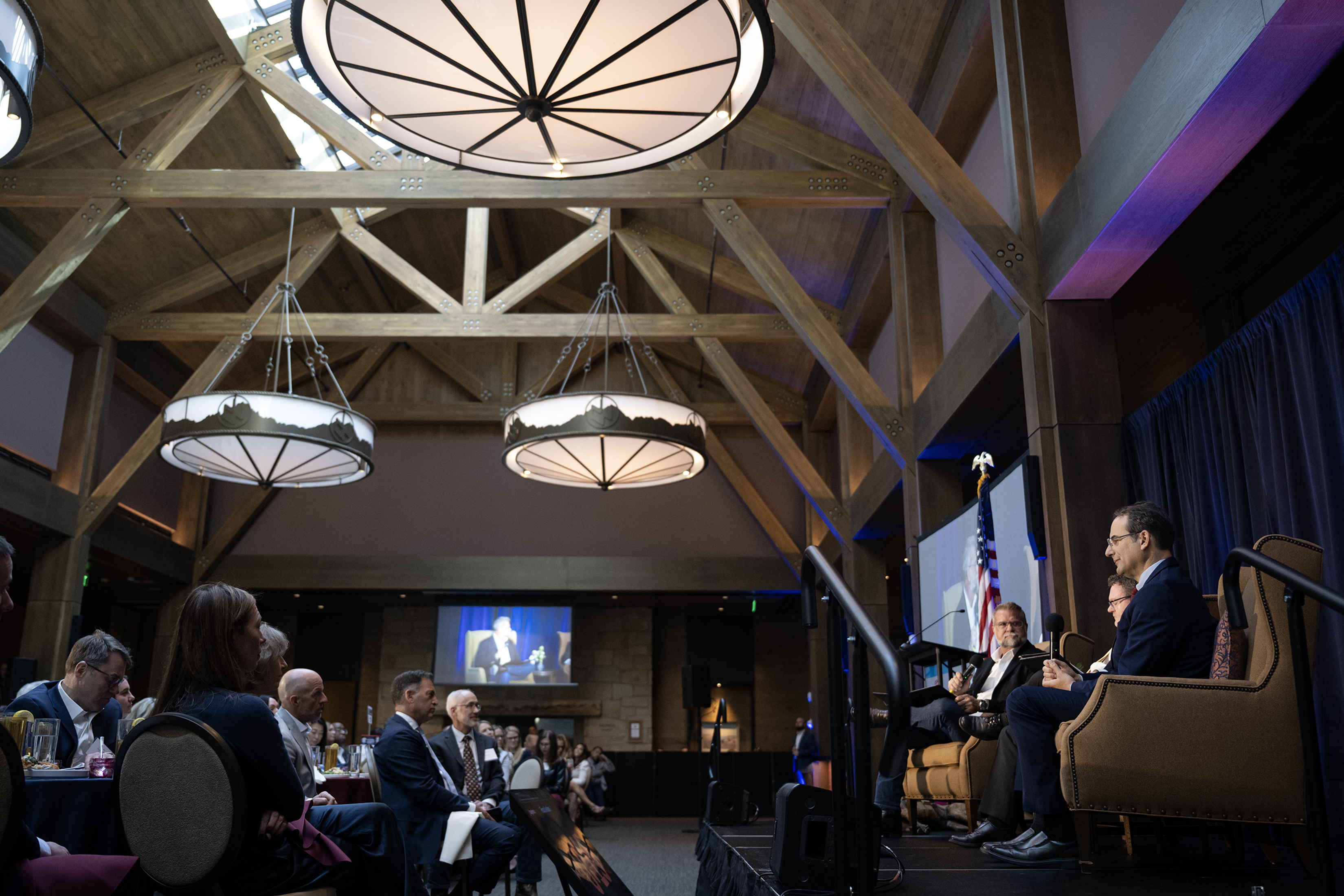
Republican Victor Marx and Democrat Phil Weiser shared the stage for the first — and likely only — time in the race for governor at a strictly managed forum hosted Thursday by the Colorado Chamber of Commerce.
The forum focused on business and economic policy. One question asked about the need for new state revenue, versus keeping tax policy the same while state officials manage their way out of Colorado’s repeated budget deficits in recent years. Voters will decide several tax questions this November, including one that would raise income tax rates on the very wealthiest Coloradans and a countermeasure that would further commit to the 4.4% flat rate the state currently has.
Weiser, the state’s two-term attorney general, called the question a “classic false choice.” The state does have problems with overspending on things like Medicaid transportation services; for a decade, the state also has spent less than constitutionally required on education, he said.
Marx, a first-time candidate and former nonprofit ministry leader, said he’d target administrative growth, outside consultants, duplicative technology and other inefficiencies for cuts, though specific proposals would have to wait for an audit of state functions.
“Before the government asks for any more of our money, it should prove that it can actually manage our money,” Marx said.
Marx has refused most traditional, moderated debates and pulled out of ones that were planned after he won the GOP nomination in the early summer. Weiser has maintained that he’d welcome chances to test his ideas against Marx in a moderated setting.
Marx opened the forum with much of his same stance, questioning the usefulness of such events, saying that “answering these questions is like moving furniture in a burning house.”
For the chamber’s event, hosted at The Legacy building at the National Western Center in Denver, the candidates received the verbatim questions in advance. Marx appeared to read from notes throughout. Weiser did not have notes.
In a scrum with members of the media afterward, Weiser confirmed receiving questions ahead of time but said he didn’t need them. He noted appearances across the state in which he’d talked to voters in unscripted events.
“The voters know that I will show up anywhere and everywhere, and answer questions from everyone. I don’t need the questions in advance,” Weiser said.
Marx did not speak to journalists after the event.
Earlier, another question to the major-party candidates focused on recent debates about modifying the Labor Peace Act, the state’s longtime unique requirement that newly forming unions hold two votes before they can collect dues. The legislature has passed bills repeatedly doing away with the second vote requirement, only for Gov. Jared Polis to veto them.
Weiser called the law antiquated and said he’d want to convene business and labor interests to find a way to reform it.
Marx pivoted from the question on reforming the law to a discussion of socialism and communism, and he said there needed to be broader economic reforms so that young people felt there was a future for them. He added that he’d convene negotiations with business and labor representatives, but otherwise straddled the issue by saying he’d respect individual worker rights and collective bargaining rights.
Both also addressed the booming debate on data centers, each saying they would bring a commonsense approach. Marx called it the collision of energy policy and economic policy. He doesn’t want Colorado to fall behind on new technology, he said, and touted the money it has brought to other areas. But he said data centers needed to pay their own way.
“It’s a great boost to our economy, but I believe in local control of what each county wants to do,” Marx said.
Weiser warned against communities “having data centers shoved down their throats,” or the large centers being built near healthcare facilities or senior centers. He also said the state needs assurances that data centers are consistent with the state’s clean energy and water goals, and that they won’t saddle local ratepayers with higher electricity bills.
But he saw an opportunity to help with coal plant communities achieve a “just transition” as that fossil fuel is phased out. Places like Craig in northwest Colorado could use geothermal energy to power the data centers, giving an economic boost to an area otherwise on the ropes, and keep the new technology from encroaching on neighborhoods throughout the state, he said.
Toward the end of the event, Marx did force the conversation out of the otherwise scripted confines of the forum by demanding an apology from Weiser.
Marx has come under fire recently for laughing comments he made about throwing his wife into a door as part of a self-defense discussion.
But even this break from the event had its own script. Marx’s campaign distributed QR codes at the event that linked to his campaign website and his context about the comments. His wife, Eileen, has said she didn’t consider the incident domestic violence.
Marx asked Weiser to apologize for tying him and his wife to domestic violence.
Weiser responded that he was focused on separate comments Marx had made about girls and women needing to be “content with where God has them.” Marx has argued that he was not defending domestic violence, but trying to support young women who face pressure to settle for abusive relationships. Weiser said it was blaming the victims.
“To someone who has been abused, it is not your fault,” Weiser said. “It is our job as leaders to support you, to take domestic violence seriously.”
As Marx tried to argue for more context, the crowd at the chamber luncheon applauded Weiser.
Stay up-to-date with Colorado Politics by signing up for our weekly newsletter, The Spot.


